
User Guide
Account Registration & Approval
To ensure the security and privacy of match data, Rugby Game Tracker operates on an invite/approval basis.
- Registration: Click the Register tab on the login screen to create a new account. You will need to provide your email address and create a secure password.
- Email Verification: After registering, you will receive an email from Supabase to verify your email address. If it doesn't arrive within a few minutes, please check your junk or spam folder.
- Awaiting Approval: Once verified, you will be logged in but placed on an Awaiting Approval screen. You will not be able to access the tracker until an administrator reviews and approves your account.
- Administrator Approval: An admin will receive an email notification of your registration. Once they assign you a role (User or Admin) and approve your account, you can refresh the application to gain full access to the tracker.
Getting Started
Welcome to the Rugby Game Tracker! This application allows you to seamlessly log match events, track player sin-bins, maintain an active game timer, and visualize statistics dynamically.
- Start Blank Match: Quickly start an ad-hoc match session without needing premeditated teams from the database.
- Load a Match: Choose pre-configured matches from your saved database for a full roster experience.
- Instant Play (No Squad Setup Required): If you haven't selected or loaded a squad in advance, you can still proceed with the match immediately! The tracker automatically pre-assigns standard rugby position numbers (#1 Loosehead Prop, #2 Hooker, #3 Tighthead Prop, ... up to #15 Fullback and replacements #16-#18+), allowing you to log all match events by number (1, 2, 3, 4, etc.) without delay.
- Account Indicator: Your logged-in account email address is prominently displayed in the top header.
Pre-Match Setup & Squad Size Workflow
To ensure a smooth tracking experience on match day, follow this best-practice sequence of events (optional for detailed squad tracking):
- 1. Manage Teams, Matches & Master Player Database:
- Teams Manager: Features a side-by-side 2-column layout (Add Team form on left, Saved Teams list on right). Click
✎(Edit) to update team names or club logos. - Matches Manager: Configure KO Date, KO Time, Home vs Away team selections, and filter saved fixtures with the Filter by Season dropdown (e.g.
2026/27,2025/26). The full-height Saved Matches list features count badges and quick Load, Edit, and Status Toggle (Mark Completed / Reopen) buttons. - Master Player Database: Maintain your master player repository using a 2-column layout. Use the compact Upload CSV File button and 📥 Sample CSV tool (`Name, Club, Player_Sponsor` format), assign optional Player Sponsors, or filter players by club using Filter by Club. Duplicate checks match on Name + Club automatically. Click
✎(Edit) on any player to open the Edit Player modal, which features a Club dropdown (with an on-the-fly➕ Add New Club...option) and an editable Player Sponsor field.
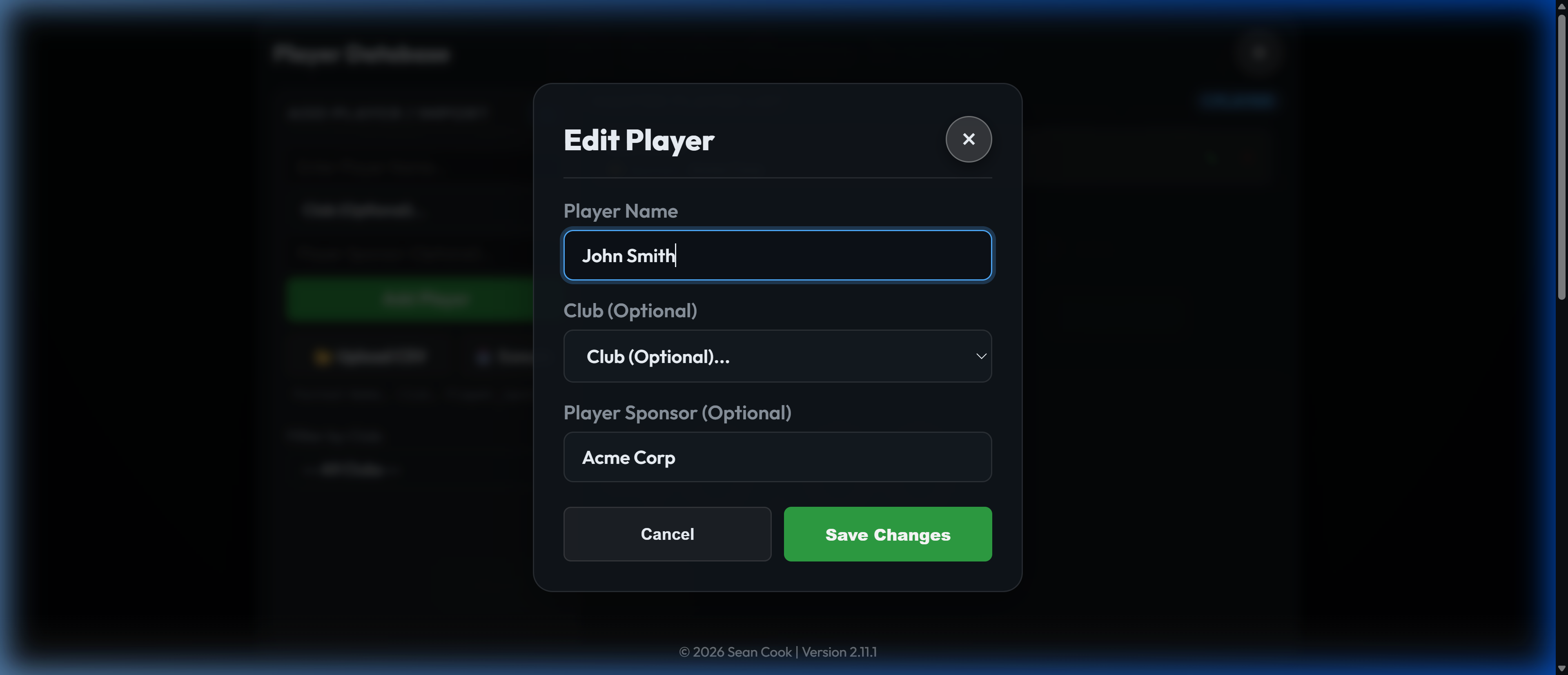
Figure 1: Editing a player in the Master Player Database — featuring the dedicated Edit Player modal with Club dropdown and Player Sponsor field. 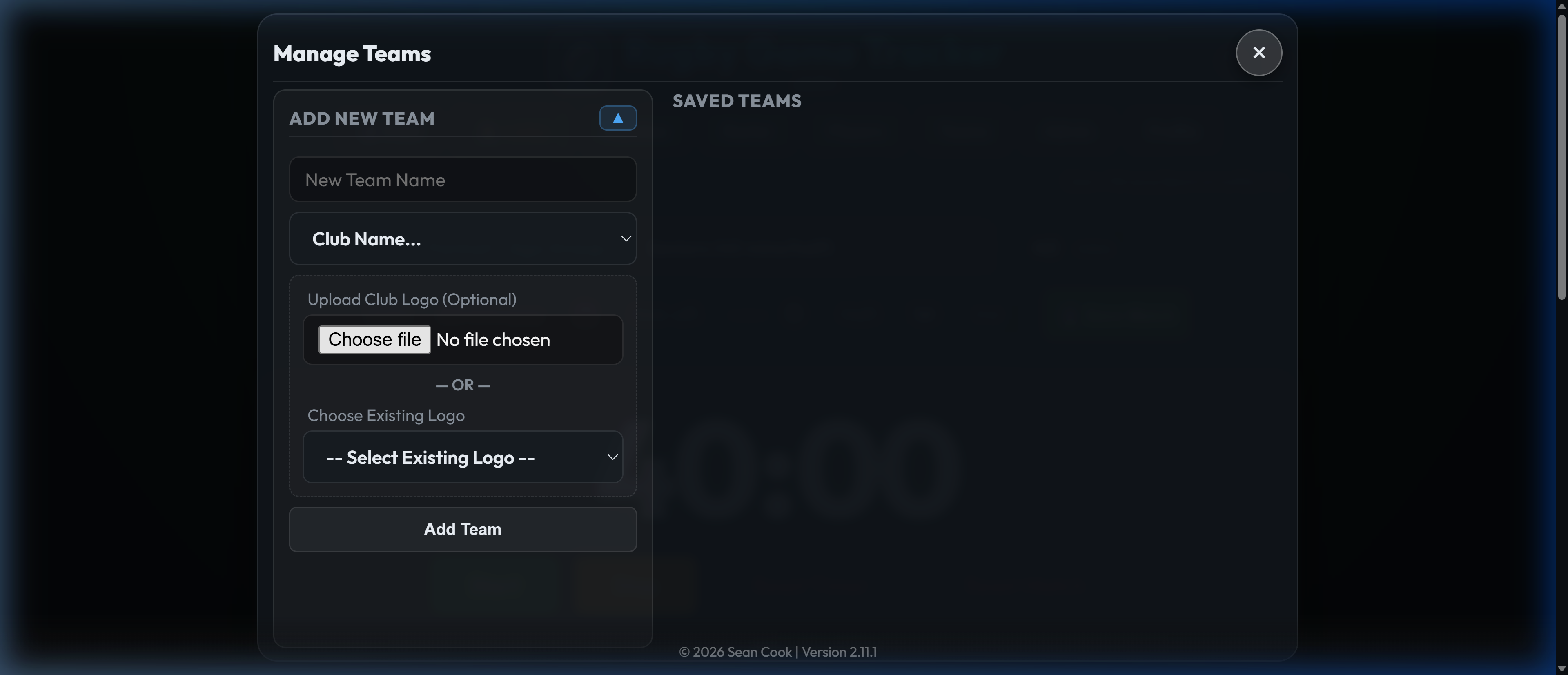
Figure 2: Teams Manager — 2-column side-by-side layout for adding teams, uploading club logos, and browsing saved clubs. - Teams Manager: Features a side-by-side 2-column layout (Add Team form on left, Saved Teams list on right). Click
- 2. Create the Playing Squad: Head to 'Players' (Database) to securely add individual squad members and link them to their respective team.
- 3. Configure Squad Size: On the 'Roster' tab, use the Squad Size controls to match your matchday squad size (defaults to 18):
- Use the tactile
-and+stepper buttons or type a number directly into the Squad Size box. - Click quick preset buttons (18, 20, 22, or 23) to switch squad limits with a single click.
- Auto-Expansion: When opening a match roster, the tracker automatically expands the squad size selector to match the highest assigned player number (e.g. #37), ensuring all squad entries are immediately visible.
- Your configured squad size automatically extends or contracts the roster line items and updates all match event player dropdowns dynamically. Your preference is remembered across sessions.
- Use the tactile
- 4. Allocate the Roster: Pull players from your squad database into specific starting positions and replacement slots for the match. If no custom squad is loaded, default numbers #1 through #18+ remain active automatically. You can also click
✎(Edit) on any roster slot to customize the player's name or assign/update their Player Sponsor, which automatically synchronizes back to your master database.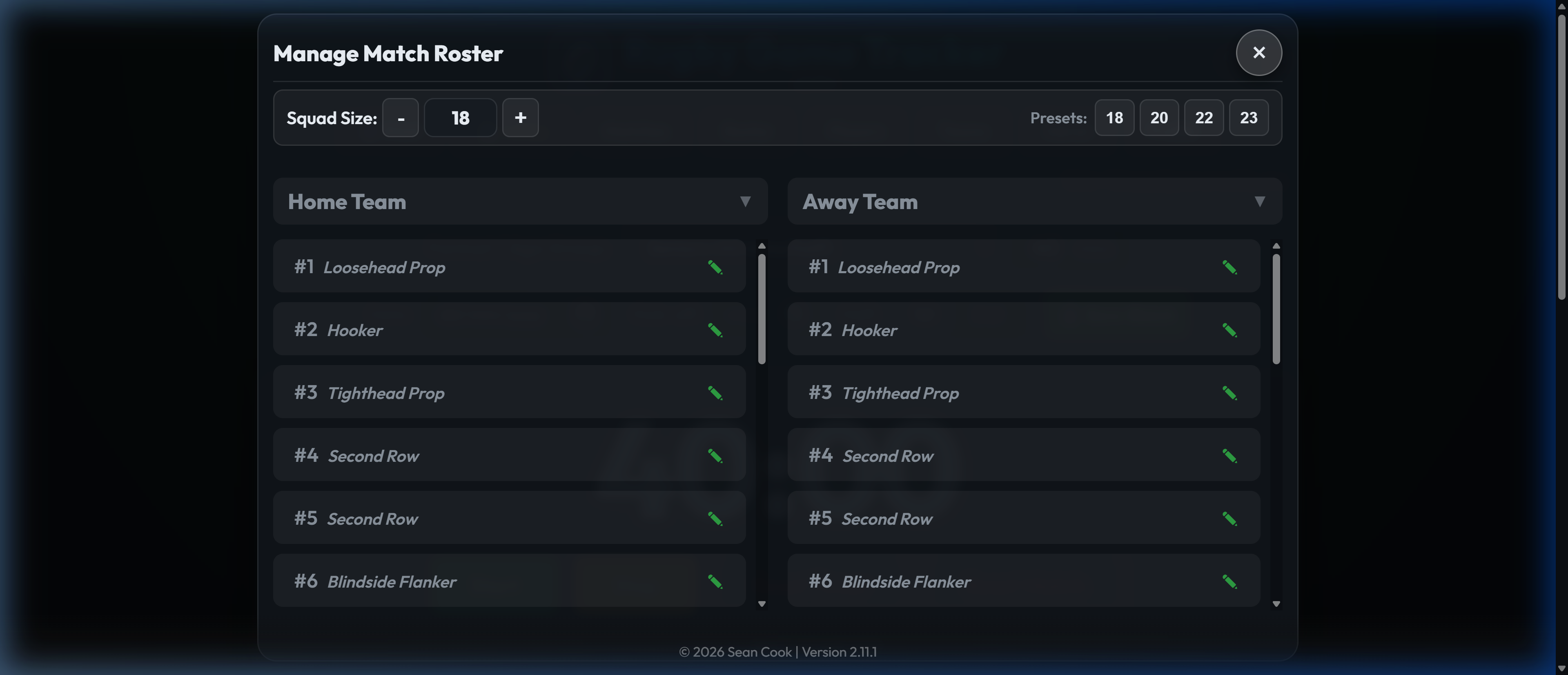
Figure 3: Manage Match Roster — squad size stepper (- / +), quick presets (18, 20, 22, 23), and per-slot player / sponsor customization.
Mobile, Tablet & Laptop Navigation
The Rugby Game Tracker is optimized for all screen sizes, including laptop displays and smartphones in Portrait and Landscape orientations (e.g., iPhone 16):
- Responsive 2-Column Views: On laptop screens and mobile devices in landscape mode, management tools (Teams, Matches, Database) automatically adopt side-by-side columns to give scrollable lists 100% of available height alongside the input forms.
- High-Visibility Circular Close Button: Management modals feature a prominent circular
×close button with a minimum 44px tap target area (conforming to Apple iOS HIG guidelines) and safe-area inset protection so it is never clipped by mobile browser URL bars, camera cutouts, or Dynamic Islands. - Outside Tap to Dismiss: You can also tap anywhere on the dark backdrop overlay outside a modal window to dismiss it instantly.
- Smooth Touch Scrolling: All fixture lists, roster lines, and master player tables feature native iOS momentum touch scrolling and high-visibility custom scrollbars.
Security & Privacy
Your data is protected by strict Row Level Security (RLS), stored-XSS HTML escaping, and automatic offline write resilience:
- Data Protection: You will only see content (players, matches, rosters) created in your account, while global RFU teams are accessible out-of-the-box.
- Input Sanitization: All team names, player names, and event comments are automatically sanitized and HTML-escaped to prevent cross-site scripting vulnerabilities.
- Write Resilience: If network connectivity drops during match logging, changes are safely queued locally and synchronized automatically once reconnected.
Match Management & Clock
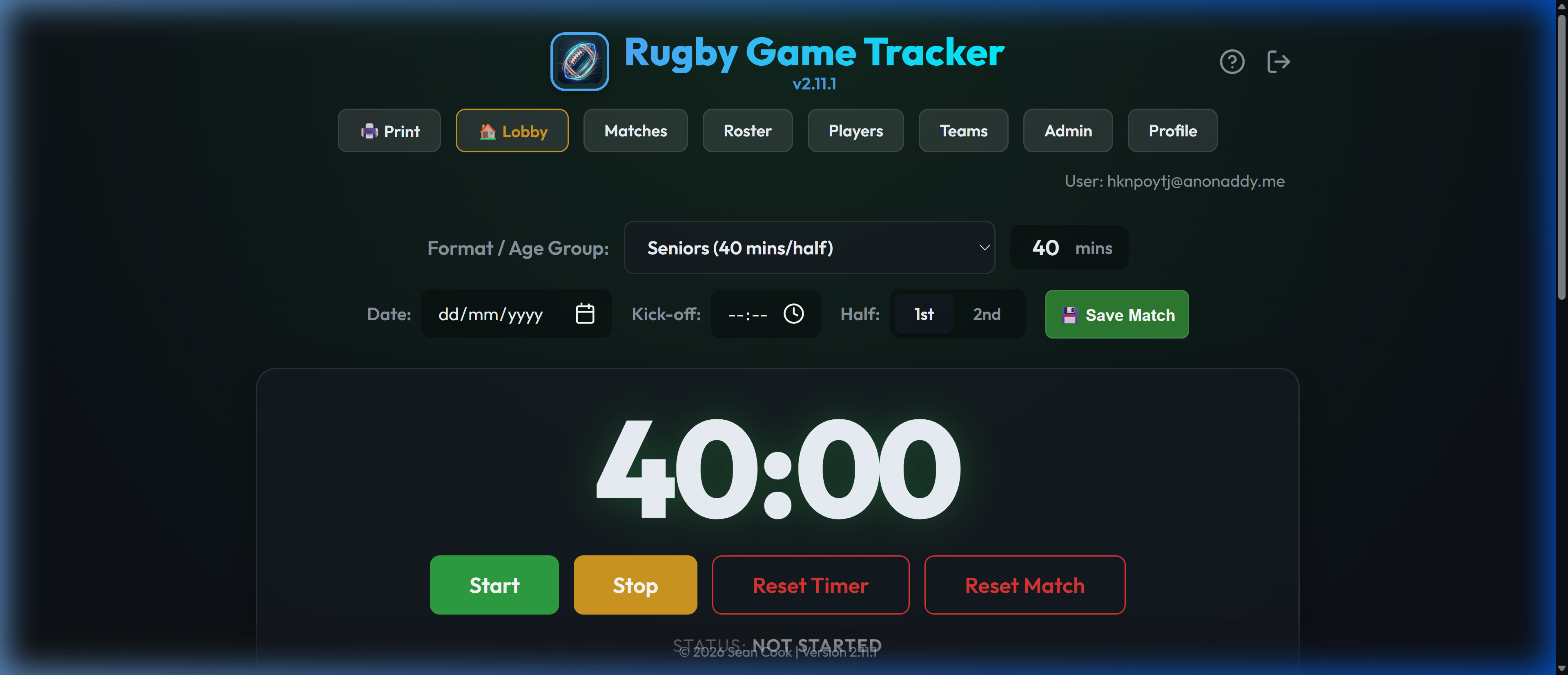
Use the settings row at the top of the tracker to configure the match variables precisely.
- Format & Age Group Dropdown: Select match durations using the sleek Format / Age Group dropdown — featuring RFU youth presets from U7/8 (10m), U9/10 (15m), U11/12 (20m), U13/14 (25m), U15 (30m), U16 / Colts (35m), Seniors (40m), or select Friendly for pre-season matches with customizable sessions (e.g., 3 x 25m or 4 x 20m sessions).
- Timer Controls: Start, pause, and reset the match clock right from the central control hub.
- End Period / Half: When the session timer depletes to zero (or when ended manually), click to transition seamlessly into the next period (Session 2, Session 3, etc.) until Full Time.
Recording Match Events
Use the interactive scoreboard interface to administer points and discipline:
- Scoring: Click Try (5), Conv (2), Pen (3), Drop (3), or Pen Try (7) to allocate points and instantly update the match timeline.
- Player Assignments: For try events, penalties, and cards, prompt windows will let you select squad members by name (complete with their
🤝 Sponsorbadge) or assign events directly using default player numbers (#1, #2, #3, #4, etc.) if no custom squad has been loaded. - Discipline: Use standard Yellow/Red Card tracking. Players awarded a Yellow Card will automatically spawn a 10-minute Sin Bin countdown timer on the user interface.
- Substitutions: Document tactical or injury substitutions swiftly to maintain an accurate team topology on the pitch.
Retroactive Event Ledger
The application persists a robust chronological ledger of all actions under Match Events.
- Forgot an event? Click the round
+button located above the event list to embed an action strictly from the past. The system will auto-sort the timeline and re-calculate all subsequent running scores flawlessly. - Corrections: Any flawed entry can be purged by utilizing the respective delete (Trash Can) icon associated with the timeline item.
Reviewing Completed Matches
When a match status is set to Completed, the main match tracker switches to a clean read-only mode:
- Read-Only Mode: Active timer controls, scoring buttons, and match setup menus are hidden to prevent accidental edits while viewing historic match results.
- Expanded Events View (Desktop/PC): On PC and large desktop displays, the Match Events list automatically stretches to fill the bottom of the screen, providing maximum visibility for reviewing every match event, try scorer, and disciplinary action without wasted screen space.
Sharing the Results
Whether broadcasting half-time scores or full-time summaries, your efforts shouldn't stay local:
- Native Mobile Sharing & Social Graphic: Click
📷 Share to Socialsnear the events ledger. On mobile devices, this opens your native OS Share Sheet (WhatsApp, X/Twitter, Messages, Instagram, Mail) with a custom social graphic featuring the match header, current score, line-level running score badges, and the last 6 match events (including substitutions, yellow/red cards, and scores). On desktop computers, it automatically downloads a high-resolution PNG graphic. - Physical & PDF Export: Leverage the Print function from the navigation menu to output a clean PDF record of the game and timeline events. The summary automatically adapts to your match format — for standard matches it reports Half 1 and Half 2 scores, while for multi-session friendlies (e.g. 3 x 25m thirds or 4 x 20m quarters) it dynamically calculates and displays scores for Session 1, Session 2, Session 3, etc., alongside Total Match Score and Tries.